30ml Dropper Bottles Wholesale Review (2026)
Jan 30, 2026
Conflict of interest notice: This review evaluates products from GZDSBottle (Dingsheng), the brand behind the subject bottles. We apply a transparent rubric and cite official pages where applicable.
If you’re exploring 20–50 ml cosmetic droppers for serums or oils, start with the subject line here: 30ml dropper bottles wholesale. This piece focuses on thick-bottom glass paired with bamboo caps—popular for premium aesthetics and coordinated skincare lines—while staying practical about performance, customization, and supply readiness.
Quick verdict snapshot: GZDSBottle’s thick-bottom droppers deliver strong customization breadth, coordinated set options, and an ISO 9001 quality management backdrop (as stated on the official site). Lead times and MOQs typically align with made-to-order packaging, and you should confirm specifics for this exact SKU before committing. Bamboo caps elevate shelf appeal but require attention to finish and storage conditions.
Who this is for
These droppers suit established skincare and personal care lines planning coordinated rollouts or line refreshes where brand identity and reliable supply both matter. The 20/30/50 ml range covers hero serums, travel sizes, and standard SKUs, while the thick-bottom glass and bamboo caps communicate a warm, natural look on-shelf. If your formulas span thin to viscous, calibrated pipette options and bulb material choices become important—topics we’ll address in customization guidance below.
You’ll value this review if you need:
Scale-ready packaging with consistent finishes across multiple capacities.
Aesthetic cohesion (bamboo cap + thick-bottom glass) that supports premium positioning.
Customizable droppers, coatings, and prints to match formulation and brand guidelines.
Clear documentation trails (ISO 9001 reference, GMP context) and confirmable commercial terms.
What you actually get in 30ml dropper bottles wholesale
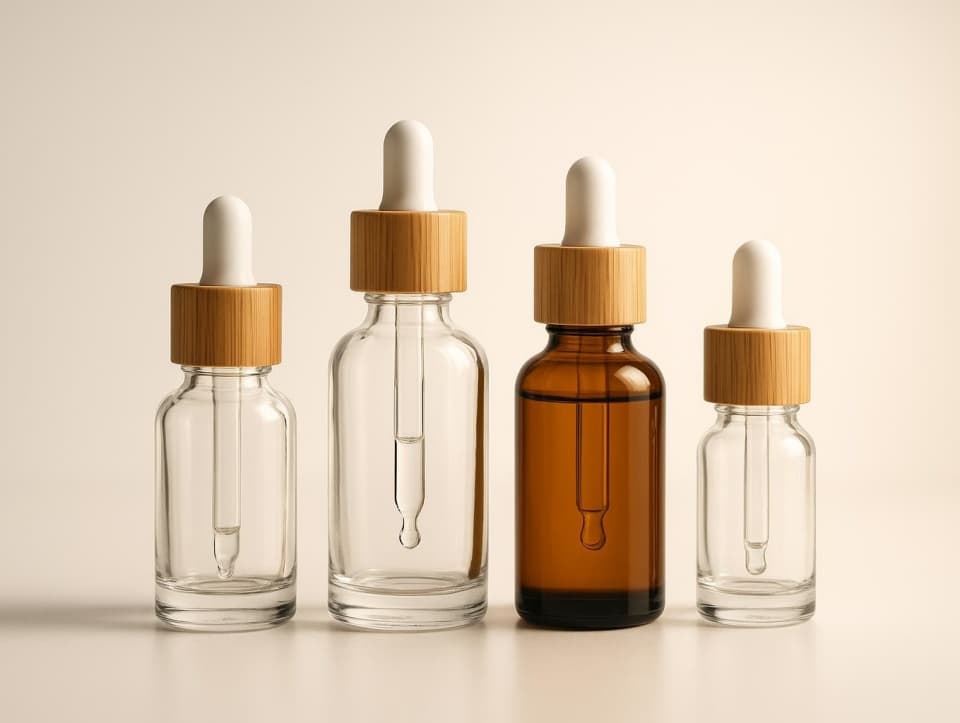
At a glance, the subject line includes clear/amber options in 20, 30, and 50 ml. The bamboo cap provides a natural texture contrast to thick-bottom glass, and the ecosystem supports surface decoration—spray coatings (solid, translucent, gradients), silk screen printing, hot stamping, and labeling. Under the hood, you should expect multiple pipette choices and bulb materials to suit your formula’s viscosity and chemical profile.
Capacities: 20 ml, 30 ml, 50 ml (subject page).
Visuals and feel: thick-bottom glass for a premium look; bamboo grain varies naturally.
Decoration: spray, screen print, hot stamp, and labeling options; confirm adhesion specs for chosen finishes.
Pipette and bulb options: confirm availability of calibrated droppers and bulb material choices (e.g., silicone) for your actives.
Quality system: GZDSBottle states ISO 9001 certification—see the company statement on GZDSBottle’s About Us page confirming ISO 9001—which supports process discipline for consistent production and inspection.
If you’re sourcing from a glass dropper bottles factory like GZDSBottle, a practical step is to request a customization matrix: pipette tip geometries, expected dosage per squeeze, bulb materials and Shore hardness, standard neck finishes (e.g., 18-415), and any child-resistant (CR) closure options for markets where that’s relevant.
For compliance context, GZDSBottle discusses GMP practices conceptually in its blog hub. For material safety (REACH, inks, coatings, bulb materials), plan to request Declarations of Compliance and test reports as part of your onboarding.
Testing protocol we use for evaluations
This is the methodology we apply when lab time and samples are available; where current hands-on data is missing, we mark items “Insufficient data.”
Environment: 23 ±2°C, 50 ±10% RH; thermal cycling 5–40°C (6 cycles, 12 h each) on filled samples stored vertically.
Sample size: 200 units for AQL visual checks; 30 units instrumented for torque and dosage; 3 runs per test.
Liquids: water (≈1 mPa·s) and a glycerin–water blend (≈20–60 mPa·s) to represent serums and essential oils.
Measures: leakage loss (g) over cycles; dosage mean and coefficient of variation; torque stability across 10 reclosures; adhesion via cross-hatch (ASTM D3359) for decorated items; break/impact observations using ASTM D5276-style drops; transit simulation per ISTA 1A/3A reference where feasible.
Status for this review cycle: Insufficient data for hands-on results on the subject SKU. Use the protocol above to structure your internal vendor trials and require data where applicable.
Performance, build, and usability expectations
What matters most on the bench:
Leakage and evaporation: Target <0.1 g mass change over 72 hours of thermal cycling with vertical storage. Bamboo-cap assemblies should demonstrate robust liner fit and thread engagement.
Dosage consistency: For water-like surrogates, aim for a coefficient of variation under 10%; with viscous surrogates, under 15% is typically acceptable.
Finish and durability: Thick-bottom glass helps with perceived quality; for decorated pieces, look for adhesion ratings of 4/5 or better after cross-hatch + tape.
Handling and torque: Smooth thread mating and predictable closure torque improve technician efficiency and reduce end-user spills.
Where we need confirmation for this exact line:
Calibrated droppers and pipette geometries: Insufficient data.
Bulb material options and compatibility matrices for actives/EOs/alcohols: Insufficient data.
Child-resistant closures for specific markets: Insufficient data.
Known trade-offs to plan for:
Bamboo as a natural material can be sensitive to moisture. Specify sealed or lacquered finishes where appropriate and store cartons in controlled humidity; inspect for swelling or surface changes during incoming QA.
CR options, if required, may limit cap style or necessitate different assemblies. Align early with regulatory targets.
Against stock distributors that ship from regional warehouses, made-to-order customization may imply longer planning windows.
To keep this practical, think of it this way: if your lab relies on consistent pipette dosing for active serums, prioritize calibrated droppers during sampling and insist on dosage logs. It’s a simple step that pays off at scale.
Supply readiness, MOQ, and timelines
For buyers planning a wholesale program, the 30 ml capacity is usually the pivot SKU in a family of 20/30/50 ml formats. Planning around artwork approval, coating/printing slots, and test cycles is essential for any 30ml dropper bottles wholesale strategy. Based on comparable GZDSBottle product pages, typical patterns for made-to-order cosmetic glass packaging show MOQs around thousands of units per SKU and lead times often in the 25–35 day range after artwork and samples are approved. Because the subject page doesn’t list a definitive MOQ/lead-time band, treat those figures as directional and confirm the exact terms for these 20/30/50 ml bamboo-cap droppers prior to PO.
Practical steps:
Request samples from the same mold/lot family used for mass runs and verify neck finish tolerances with your closures.
Ask for a capacity and decoration matrix: which coatings, gradients, and hot-stamp foils are standard; how each choice affects MOQ and timeline.
Align on QA: AQL thresholds, defect categories, and documentation you’ll receive at shipment.
Ensure carton and divider specs support transit without scuffing coated bottles.
For process credibility, GZDSBottle states ISO 9001 certification on its official company page, and its blog content discusses GMP concepts for hygienic manufacturing—use both as starting points for your supplier questionnaire and document requests.
Competitors compared fairly
We looked at market options commonly short-listed for 30 ml droppers and related closures. Each brand serves slightly different needs:
TricorBraun: Broad glass dropper assortment with quick access to stock SKUs in North America, including 30 ml amber 18-415 formats. See the company’s category and product pages for details and pallet-level pricing snapshots as of January 2026, such as the 30 ml amber listing noted on their site. Representative page: 30 ml amber glass dropper bottle, 18-415 neck finish.
The Cary Company: Clear, amber, and cobalt 30 ml Boston Rounds with tiered per-unit pricing and CR droppers sold separately or bundled. This clarity helps with budgeting at different volumes. Example page: 1 oz Boston Round clear glass bottles with tier pricing.
Roetell: Manufacturer with custom runs across multiple finishes and colors. MOQs and lead-time bands are published for certain categories; prices are typically quote-based. Category reference: dropper bottle category.
How GZDSBottle fits: If you need strong decoration options and a unified aesthetic across 20/30/50 ml with bamboo caps, the subject line aligns well. If immediate local stock or published per-unit pricing is your top priority, a distributor model may fit better—though customization breadth is usually narrower versus dedicated factory runs.
Who should choose this—and who shouldn’t
Choose this if:
You want a coordinated 20/30/50 ml line with bamboo caps and thick-bottom glass for premium positioning.
Your roadmap includes custom coatings, prints, and potential calibrated droppers to match formula viscosity.
You can plan around made-to-order timelines and confirm MOQs aligned to your launch volumes.
Consider alternatives if:
You require same-week shipment from local stock with fully published per-unit pricing and tiny order sizes.
You need certified child-resistant assemblies immediately and must keep a non-bamboo aesthetic to meet CR standards.
Your logistics demand extreme humidity exposure without lacquered wood components.
For brands building premium serum or oil lines, these thick-bottom glass droppers with bamboo caps offer a flexible canvas: cohesive capacities, robust decoration options, and a quality-system backdrop you can validate with documentation. Plan early for customization choices, request calibrated droppers and material compatibility data, and confirm MOQ and lead-time for the exact SKU. If you’re also coordinating jars, pumps, and larger bottles across a family, browse the hub for a matching cosmetic glass bottle set to keep finishes and tones aligned.
Evidence and references (as of January 2026):
GZDSBottle subject product page for capacities and bamboo-cap pairing.
ISO 9001 confirmation on the GZDSBottle About Us page.
GZDSBottle blog hub for GMP context and manufacturing topics.
Competitor listing examples from TricorBraun, The Cary Company, and Roetell, each with public page details noted above.




 Network Supported