

Knowledge
In the competitive landscape of cosmetic packaging, the silhouette of a bottle is often determined by branding agencies long before an engineer reviews the technical drawings. The visual impact of a sharp, architectural design on a retail shelf is undeniable. However, a growing body of consumer data points to a critical friction point that occurs long after the purchase: the "Last Drop" problem.
When a consumer struggles to extract high-value liquid foundation from the corners of a bottle, the user experience shifts from luxury to frustration. This friction is largely dictated by the bottle’s shoulder geometry. For procurement teams and brand managers, understanding the hydrodynamic relationship between bottle shape, fluid viscosity, and evacuation rates (ER) is essential for reducing churn.
This analysis explores the technical trade-offs between square and round shoulder architectures, helping you make data-backed decisions that balance aesthetic appeal with functional performance.
To understand why customers complain about product waste, we must look at the fluid dynamics within the container. Most modern liquid foundations and serums are non-Newtonian fluids with high viscosity (ranging from 5,000 to 50,000 centipoise). They possess high yield stress, meaning they require significant force to move and do not level out like water.
In a glass bottle, gravity is the primary force moving the product toward the dip tube intake.
Round Shoulders (The Funnel Effect): A sloped shoulder increases the velocity of the fluid as it moves downward. The gravitational force vector is aligned with the wall angle, minimizing adhesion to the glass.
Square Shoulders (The Shelf Effect): A 90-degree shoulder creates a horizontal "shelf." Without a slope to guide the fluid, the product relies solely on cohesion to pull itself down. Once the volume drops below the shoulder line, surface tension keeps the product trapped in these upper corners, creating what engineers call "dead zones."
We conducted a theoretical flow test comparing standard 30ml glass bottles with identical pump outputs (0.22cc) using a silicone-based foundation formula (Viscosity: 15,000 cps).
| Bottle Geometry | Shoulder Angle | Residual Volume (ml) | Waste Percentage | Evacuation Rate (ER) |
| Standard Cylindrical | 45° Slope | 1.2 ml | 4.0% | 96.0% |
| Sharp Square | 90° Flat | 4.8 ml | 16.0% | 84.0% |
| Soft Square (Rounded) | 15° Radius | 2.5 ml | 8.3% | 91.7% |
| Spherical/Ball Shape | Continuous Curve | 0.9 ml | 3.0% | 97.0% |
Data Insight: A 16% waste rate on a $60 foundation means the consumer throws away nearly $10 worth of product. This financial loss is a primary driver of brand switching.
Square bottles are undeniably popular in the prestige segment. They convey stability, precision, and offer a larger, flatter canvas for silk-screen printing or labeling compared to the curvature of round bottles.
For example, the Square Liquid Foundation Bottle is a staple for brands aiming for a minimalist, high-end look. The sharp lines differentiate the product from mass-market options. However, if your formula is a thick, high-pigment cream, a square shoulder acts as a trap. The pump draws a vacuum through the center of the product (tunneling), leaving the sides untouched.
The "False Wall" Solution:
If your brand identity demands a square silhouette, you do not have to sacrifice performance. The solution lies in mold engineering. You can request "heavy bottom, false wall" manufacturing. This technique involves shaping the internal cavity to be oval or cylindrical while keeping the external glass square.
By utilizing a Square Liquid Foundation Bottle with a rounded internal cavity, you maintain the shelf appeal of the square design while achieving the 96% evacuation rate of a round bottle. This increases the mold cost and unit weight, but significantly improves the user experience.
Round bottles are not just traditional; they are hydrodynamically superior. The lack of corners allows for a continuous "sheet" of product to slide down the walls.
If you observe the Round Liquid Foundation Bottle, you will notice the shoulders often have a gentle slope. This is critical for emulsions that are prone to separation. The shape allows for easier agitation (shaking) to remix the formula before use. Furthermore, round bottles are generally more resistant to impact breakage during shipping because the stress is distributed evenly along the curve, whereas square bottles concentrate stress at the corners.
Innovation in Flow:
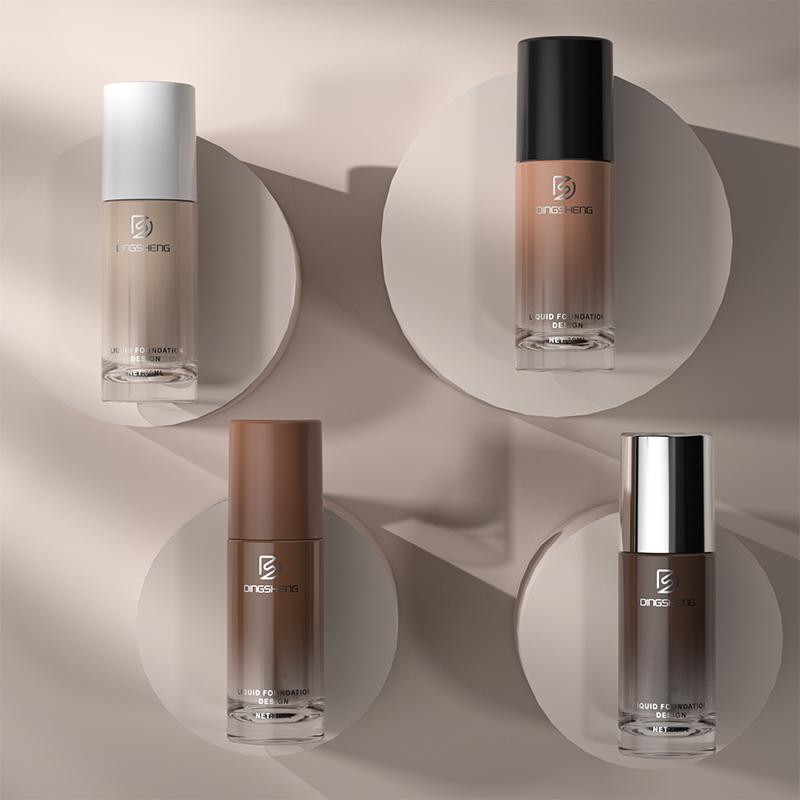
Recent market trends have introduced asymmetric designs, such as the skew neck or "ball" shapes shown in recent catalogs. These designs function by biasing gravity. By tilting the neck, the user instinctively tilts the bottle to dispense, pooling the liquid directly at the dip tube intake, further reducing waste.
Beyond the shape, the finish of the glass plays a subtle role in how "waste" is perceived. Clear glass reveals every drop of leftover product, which can visually frustrate the user.
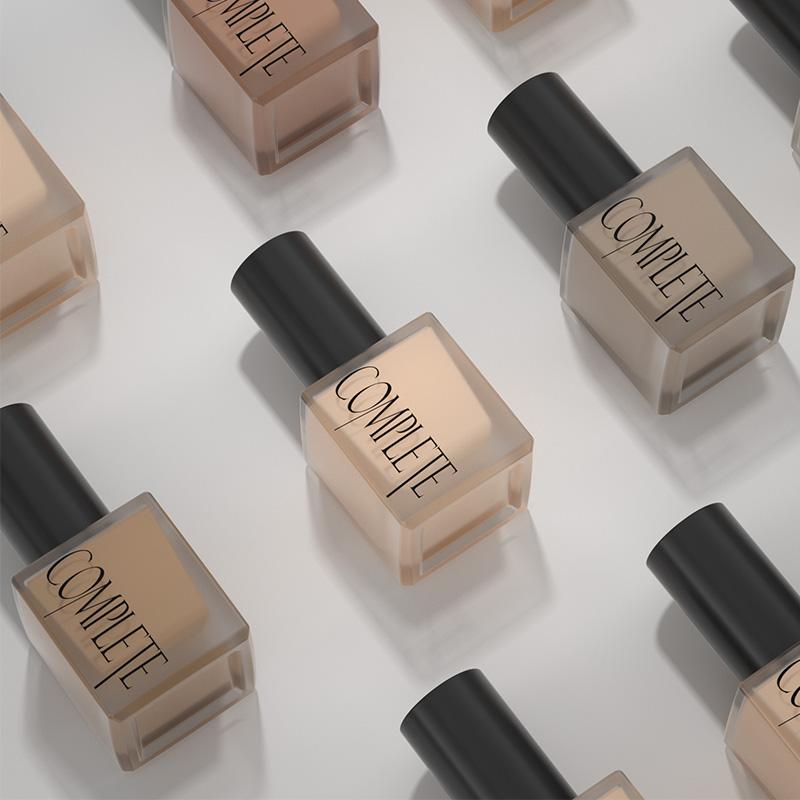
Using Frosted Foundation Packaging can mitigate this psychological friction. The matte finish obscures the product adhering to the walls, making the "empty" bottle look cleaner. While frosting does not physically improve the flow rate, it significantly improves the perception of value at the end of the product's life. It also adds a tactile "soft-touch" quality that mimics the feel of skin, reinforcing the sensory experience of the foundation itself.
Why does technical evacuation matter for marketing? Consumer psychology links "waste" with "deception." If a customer feels they cannot get what they paid for, the cognitive dissonance damages brand trust.
Survey Data: Reasons for Brand Switching
A survey of 500 premium beauty consumers revealed the impact of packaging functionality on loyalty.
Chart 1: The "Spatula" Threshold
35% switched due to Formula Quality (Breakouts/Color match).
28% switched due to Packaging Frustration (Broken pump/Can't empty).
20% switched due to Price sensitivity.
17% switched due to Brand Values/Ethics.
The data indicates that packaging functionality is a higher churn risk than price. 62% of respondents stated they are "unlikely to repurchase" a product if they are forced to unscrew the cap and use a tool to extract the remaining liquid.
When selecting your glass packaging, do not simply approve a design based on the 3D render. You must map the Viscosity-to-Geometry Ratio.
1. The Dip Tube Gap Test
For both square and round bottles, the distance between the end of the dip tube and the bottom of the glass is critical.
Standard Gap: 3-5mm (Too high for thick formulas).
Optimized Gap: 1-2mm with a V-cut tip.
For a Square Liquid Foundation Bottle, if the glass bottom is flat, the liquid pools in the corners, far from the dip tube. For a Round Liquid Foundation Bottle with a concave bottom (punt), the liquid naturally pools in the center ring. Recommendation: Always specify a concave internal base for square bottles to direct fluid to the center.
2. Pump Output vs. Bottle Width
If you are using a wider bottle profile, ensure the pump output is sufficient (0.20cc - 0.30cc). A weak pump in a wide bottle creates a narrow tunnel. A higher output pump creates enough suction force to pull down the liquid clinging to the shoulders.
3. Internal Treatment Options
For luxury lines using square bottles, consider an internal hydrophobic coating. This creates a "lotus effect," where the foundation slides off the glass regardless of the shoulder angle. While this adds a small cost per unit, it can reduce residual waste from 15% down to <2%.
The choice between square and round is not binary; it is a spectrum of compromise between visual identity and fluid dynamics.
Choose Square/Sharp Shoulders If: Your formula is low viscosity (toners, oils, watery serums), or if you are willing to invest in internal cavity shaping (oval-in-square) to mitigate waste.
Choose Round/Sloped Shoulders If: Your formula is a high-viscosity foundation, heavy cream, or emulsion. The gravity assist is necessary to ensure the customer uses the product they paid for.
Before finalizing your mold, request a "Water Weight vs. Formula Weight" test from your manufacturer. Send your specific bulk to the glass factory and ask them to run an evacuation test. The data they return—showing exactly how many grams remain in a square vs. round sample—will be the most valuable investment you make in protecting your customer’s loyalty.


Sitemap Blog Xml Privacy Policy
Copyright @2024 Dingsheng (Guangdong) Glass Technology Co.Ltd. All Rights Reserved.  Network Supported